
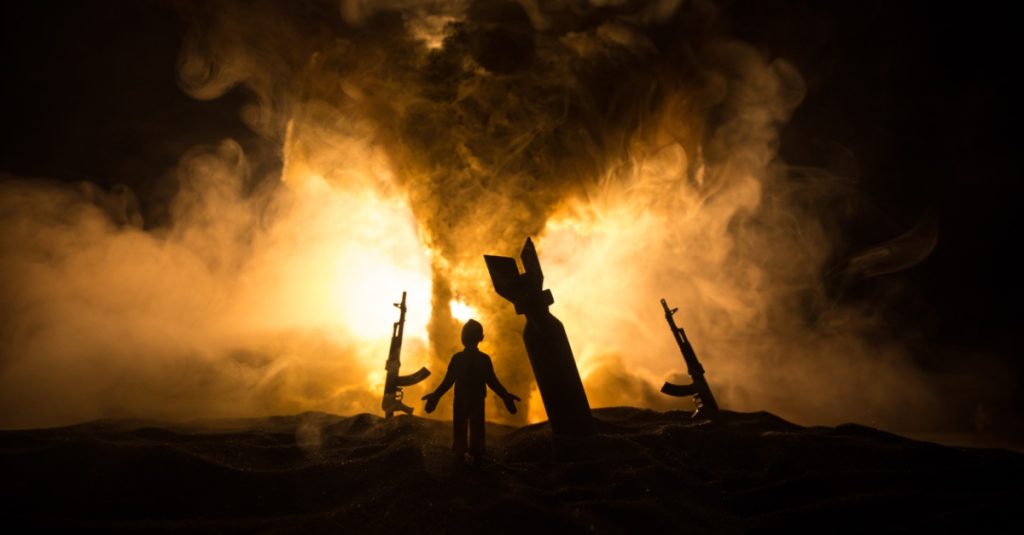
At first glance, the global system appears more militarised and confrontational than at any point since the late Cold War; no surprise there with some 60 major conflicts affecting life and limb around the world as we speak. While this is underway, defence budgets are expanding across NATO, East Asia, the Middle East and Russia, albeit at a ‘snail’s pace’ in some countries.
Regardless, the rhetoric is sharper, deterrence postures more explicit, and military technologies more advanced. Yet, beneath this surface escalation lies a striking paradox: while capability continues to grow, the willingness to use it appears to be diminishing. Escalation thresholds are rising, not falling. The world’s so-called great powers are better armed than ever, but increasingly reluctant to cross lines that might trigger uncontrollable consequences that would impact us all.
This is not a triumph of diplomacy or renewed faith in international norms. It is the product of exhaustion. Strategic fatigue, rather than reconciliation, is becoming the defining condition of global power politics.
Capability without appetite
The US, China and Russia all retain formidable military capacities. The US remains unmatched in power projection and technological integration. China has achieved regional parity in the Indo-Pacific and continues to modernise at scale. Russia, despite sanctions and battlefield attrition, has demonstrated its ability to sustain long-duration conflict and disrupt adversaries asymmetrically. These states are not weak. Yet, none show a credible appetite for escalation beyond carefully managed limits.
This restraint is often misread as caution born of rational calculation. In reality, it reflects the narrowing margins within which great powers can act. Military action no longer promises decisive outcomes. Wars drag on, sanctions harden rather than coerce, and victories fail to translate into durable political settlements. Power can be applied but not converted into control. As a result, the utility of force has declined even as its availability has increased.
Demographic constraints and the human ceiling of power
One of the least acknowledged drivers of strategic fatigue is demography. Every major power is aging. The US, China, Europe, Russia, Japan and South Korea all face shrinking working-age populations and rising dependency ratios. This erodes the social base of sustained confrontation. Large-scale mobilisation is politically toxic, fiscally burdensome and socially destabilising. The tolerance for casualties, disruption and prolonged sacrifice has collapsed.
This demographic reality reshapes strategic behaviour. Leaders may posture aggressively, but they govern societies less willing to bear the costs of escalation. The manpower pool that once underpinned total war has vanished. What remains is a preference for stand-off capabilities, proxies, automation and ambiguity – all tools designed to exert pressure without triggering mass mobilisation or domestic backlash.
Fiscal saturation and the limits of endless defence
Defence spending can rise without limit only in theory. In practice, it now competes with structural fiscal pressures that are far more politically sensitive: pensions, healthcare, debt servicing and social stability. Western states are financing rearmament through borrowing rather than growth. China faces the twin burdens of slowing productivity and mounting local government debt. Russia is sustaining wartime expenditure by cannibalising future development.
These fiscal realities do not prevent military spending, but they alter its purpose. Budgets increasingly prioritise deterrence maintenance rather than war-fighting ambition. The goal is to avoid loss, not to pursue victory. Strategic fatigue emerges when states recognise that escalation would accelerate fiscal breakdown faster than it would secure geopolitical gains.
Domestic politics as a brake on escalation
Strategic fatigue is also rooted in domestic political fragility. Polarised societies, low institutional trust and fragmented media environments reduce leaders’ room for manoeuvre. Any major escalation risks internal destabilisation.
In democratic systems, war fatigue sets in before wars even begin. In authoritarian systems, the fear is not public opposition but elite fracture and economic shock. This creates a paradoxical environment in which aggressive rhetoric is politically useful, but aggressive action is politically dangerous. Leaders signal resolve to external audiences while quietly calibrating restraint to internal ones. Escalation becomes something to threaten, not to execute.
The risk management era of geopolitics
What replaces ambition is risk management. The defining feature of current great-power behaviour is not expansion but containment of downside risk. The US seeks to deter without being drawn into direct conflict. China aims to assert influence without triggering economic decoupling or regional war. Russia pursues disruption without provoking existential retaliation.
This produces a world of persistent tension without release. Flashpoints are managed, not resolved. Conflicts are frozen, not concluded. The strategic imagination narrows from shaping the future to surviving the present. In this environment, restraint is not virtuous; it is defensive.
Strategic fatigue versus strategic stability
It is tempting to interpret rising escalation thresholds as a form of stability. In reality, strategic fatigue creates a brittle equilibrium. Because no actor seeks decisive confrontation, crises accumulate rather than clear. Miscalculation becomes more dangerous precisely because systems are overloaded. Fatigue does not eliminate conflict; it changes its form. Pressure is applied through economic warfare, cyber operations, legal manoeuvres and narrative control – tools that degrade trust without triggering resolution.
This architecture favours prolonged uncertainty. It also advantages actors comfortable operating in ambiguity, while penalising those dependent on clear rules and predictable outcomes. Strategic fatigue thus reshapes global power not by reducing competition, but by mutating it into something slower, less visible and harder to manage.
Conclusion
The world is not entering an era of peace, nor one of imminent global war. It is entering an age of strategic fatigue. Military capability remains abundant, but the appetite to use it decisively is waning under demographic and fiscal strain that is creating political fragility.
Restraint today is not the product of trust or diplomacy, but of exhaustion and risk aversion. This creates a world defined by managed tension, unresolved conflict and power that threatens. In such a world, stability is not secured by strength alone but constantly negotiated against the limits of endurance.
To download a copy of this article, please click here.