
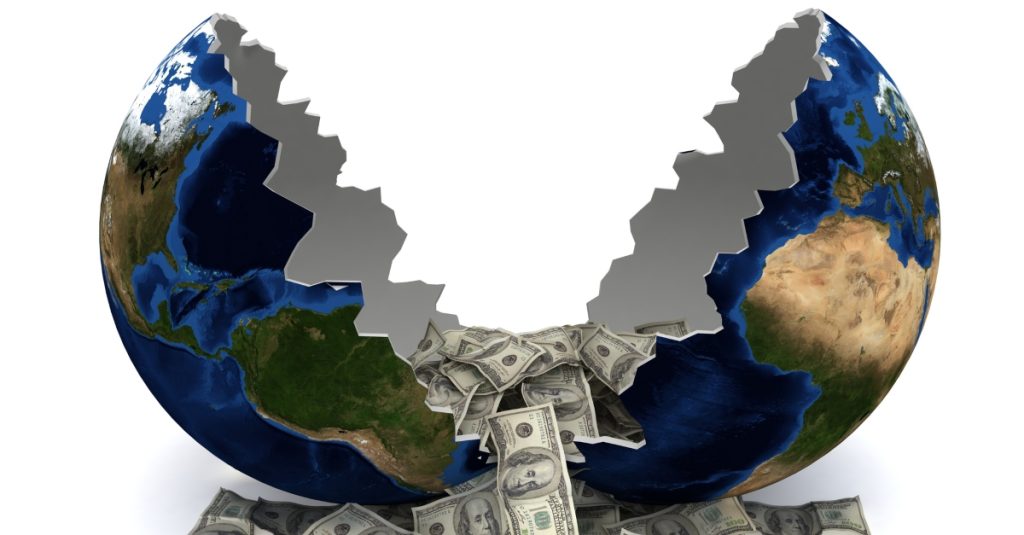
Globalist interests have enjoyed considerable influence for many decades. However, that position is now changing and at an increasing pace. Putting aside Iran and Ukraine for the moment, the world is at war between those who believe in protecting and building their countries and those who are driven to financially liquidate them to increase their wealth, then move on to another and another. Fortunately, in many respects, the majority of this ‘world war’ is taking place behind the scenes, while Western governments serve up a constant diet of economic chaos, hiding behind a facade of incompetence to draw their public’s attention away from what is really happening.
Bonds and oil are the real front of the war
Until mid-2023, Globalist financial networks maintained deep connections across major financial and commodity institutions that enabled significant influence over the pricing of key assets, including the US dollar, gold, silver, copper and oil (the last of which still being life blood of the world). These networks have been able to leverage borrowing against these collateral assets at exceptionally low rates, especially when they can leverage the same asset several times over. This facilitated access to offshore US dollars, which were then used to purchase US government bonds and maintain liquidity within the carry-trade spread between Japan and the US. However, they are beginning to lose this control.
The US Dollar was first to go
Before the US took back control of the price of the dollar with the move from LIBOR (the London Interbank Offered Rate) to SOFR (Secured Overnight Financing Rate), LIBOR was the interest rate the global banks agreed to charge each other to borrow US dollars (among other currencies), without the need to post collateral. It has been said that some US$300 trillion dollars were tied into LIBOR contracts. The system greatly benefited the Eurodollar market, where vast quantities of US dollars were held and traded outside direct US jurisdiction and oversight.
Unregulated, the banks began manipulating the rating system to benefit their own trading positions. The move to SOFR effectively returned the pricing of the offshore US dollar back into the hands of the Federal Reserve and therefore back into US control. The result has been an increasingly reduced access to Eurodollars. Competition for available liquidity has intensified, driving up borrowing costs and creating additional pressure on institutions that previously relied on abundant dollar funding.
That pressure was compounded by the termination of USAID funding programmes by President Trump in January last year. The reduction in overseas dollar flows significantly decreased the supply of inexpensive US dollars entering Europe, further tightening liquidity conditions.
Gold
The substantial gold purchasing spree of the US and China this year has added greater pressure to institutions dependent on leveraged financial structures. The London Bullion Market Association’s (LBMA) timescales of supply for physical gold delivery have extended to some 8 weeks. Some analysts are now questioning the LBMA’s claims as to how much gold is really being held in its vaults. As more paper-held gold on the futures markets gets called in, even greater pressure is applied. Added to this challenge are those institutions that maintained large short positions in gold (bets that the value of gold would drop) when the price skyrocketed.
It is interesting to note that Venezuela first requested its 31 tonnes of gold (approx. US$2 billion 2020 prices – now US$3.6 billion) reserves be returned from the Bank of England but was refused on the grounds that the UK government no longer recognised Nicholas Maduro as the country’s leader. However, they have now also refused Delcy Rodriguez, Venezuela’s Interim President, who says the country needs it for earthquake relief. Switzerland is also holding Venezuela’s gold and refusing to give it back for the same reasons. However, (officially) Switzerland is holding 127 tonnes of Venezuela’s gold (approx. US$5 billion).
In addition to these significant issues and changes, silver was not left out and hit a world-time high at the end of January this year.
Japan will not collapse the world’s economies… but maybe some globalist institutions
When it became clear that Sanae Takaishi was to become Prime Minister and worse, from the Globalists perspective, was an ally of President Trump, panic set in. Perhaps rightly. For years, Japan’s extremely low interest rates have been a cornerstone of global carry-trade strategies despite the continuing destruction to the Japanese economy it has caused since the 1990s.
Nevertheless, with the loss of so many profit-making schemes, it was essential for the Globalist institutions that Japan kept interest rates extremely low. They had been arguing loudly that if the Bank of Japan did raise interest rates it could trigger a domino effect throughout global markets. Yet, in June this year, Japan announced the first of its interest rate hikes to a 31-year high and there is talk of more to come later this year.
Conclusion
Conditions that have prevailed for decades are shifting dramatically and the pace of change is now accelerating.
To download a copy of this article, please click here.