
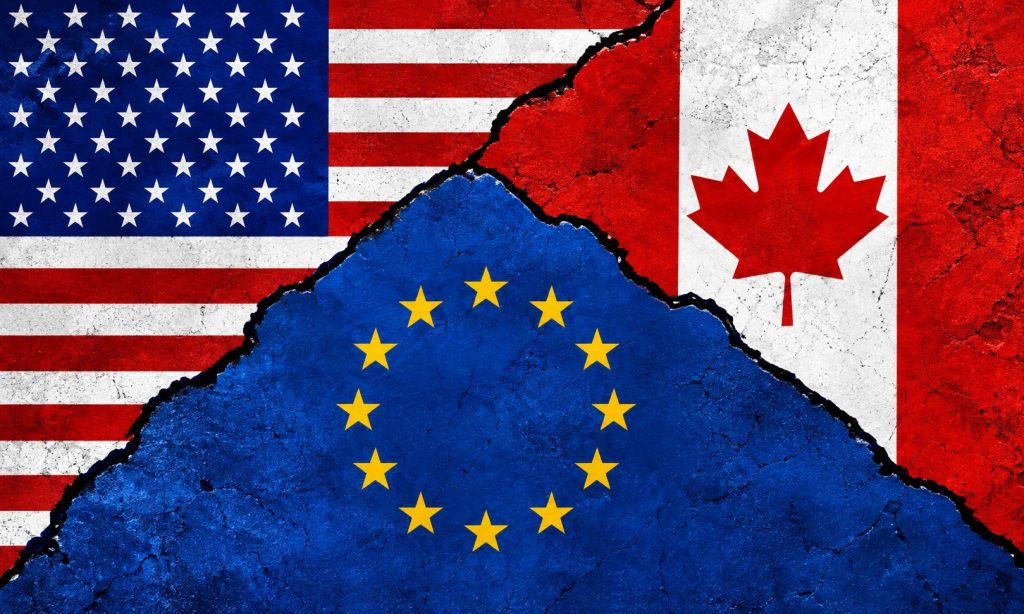
Canada’s trade talks collapse with the US should not be viewed simply as another tariff dispute between neighbours. The timing, as with everythinapse with the g in today’s world, matters. Prime Minister Mark Carney suspended negotiations on 21 August, little more than ten weeks before the 3 November mid-term elections in the US. Washington says Ottawa’s late demands became uneconomic and had stopped negotiating in good faith, while Ottawa claims the White House infringed on Canadian sovereignty.
The hard truth is that Carney never regarded a comprehensive US agreement as part of his strategy, despite his promises during the last Canadian election. On 22 August, the Prime Minister said that building at home and diversifying trade abroad was “not our Plan B” but “our Plan A from the start”. If that was genuinely Plan A, the collapse of talks cannot be explained away as something Trump forced on Canada.
Executive Summary
Carney’s plan is an attempt to move Canada away from the North American economic market and into a wider multilateral one. It appears Carney is mobilising Canadian resources, pension capital and public assets not to be fed back into the Canadian economy so as to be a strong multilateral partner to others, but rather ‘asset-strip‘ it to develop a ‘survival bailout‘ fund for the EU and its commitments to Ukraine.
Trump’s sovereigntist model is obviously moving in the opposite direction: domestic production, strategic control of resources and use of the American market to rebuild national economic power. The American Political System.
Given that Canadian talks with the EU have already begun on a deeper security and economic partnership, and that Canada has become the only non-European participant in the EU’s SAFE defence-procurement initiative, the breakdown with Washington looks less like an accident and more like a deliberate collision.
The US contributed to the dispute through new duties and demands involving autos, dairy and other sectors. But Washington did temporarily suspend some measures after Canada indicated that discriminatory arrangements would be removed. The White House later claimed Canada reversed course. Carney said the eventual American terms offered too little and demanded too much.
The record therefore does not reflect Carney’s simple claim that Trump destroyed the negotiations. Carney had already declared diversification away from US dependence to be his starting strategy.
Canada’s Assets as Strategic Leverage
Carney has created the $25 billion Canada Strong Fund to invest alongside private capital in energy, mining, agriculture and infrastructure. At the September Canada Investment Summit, Canadian pension funds, insurers and institutional investors committed almost $100 billion additional capital. CPP Investments and Brookfield announced the $50 billion Maple Fund for critical infrastructure and strategic industries.
Carney is also seeking private capital for long-term concessions over Canada’s four largest airports, expecting to raise tens of billions of dollars while retaining the underlying assets. Canada’s pension wealth, public balance sheet, infrastructure and natural resources are therefore becoming components of a much larger investment strategy.
Europe and Ukraine
Canada’s growing European commitment comes as Europe faces mounting financial pressure. The IMF expects euro-area growth of only 0.9 per cent in 2026 and warns of weak productivity, ageing populations and continuing fiscal strain. The ECB has warned that high deficits and debt, defence requirements and the fading of Next Generation EU support are reducing governments’ room to absorb future shocks.
Canada is moving closer to the EU just as those pressures are reaching boiling point. It is participating in the EU’s Security Action for Europe (SAFE), discussing a deeper EU security and economic alliance, and committing heavily to Ukraine. Carney has already pledged $2.8 billion in Canadian military assistance to Ukraine this year and has committed to sustaining large-scale support into 2027.
From a sovereigntist reading, Canada is therefore not simply supporting Ukraine. It is binding Canadian finance, industry and resources more tightly to the entire European system under increasing fiscal strain.
Conclusion
The central issue is whether Canadians themselves recognise the direction in which their country is being moved. Carney’s own language makes it clear that diversification from the US was always Plan A. His government is mobilising pension funds, public assets and natural resources, while deepening links with Europe and continuing major financial and military commitments to Ukraine.
The argument that Trump caused the rupture is therefore untrue, he just accelerated a confrontation already built into Carney’s strategy. The President is attempting to rebuild American economic sovereignty around the nation-state, while Carney appears to see himself as the ‘knight in shining white armour‘ coming to the rescue of his globalist colleagues in the EU.
To download a copy of this article, please click here.