
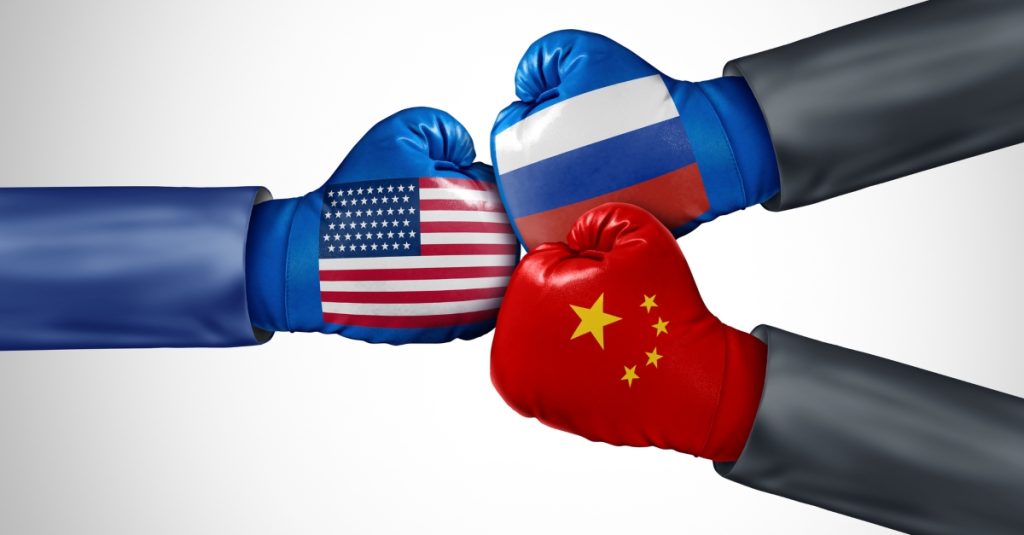
For the first time since the end of the Cold War, the world’s three largest powers (the US, Russia and China) are showing signs of drifting into a pragmatic triangular balance. It is not an alliance, and it is not ideological. It is, instead, the product of converging interests. Quiet US-Russia communications on energy and European risk management, a tentative thaw in US-China tariff discussions, and a Russia-China partnership that is becoming more transactional than doctrinal. Together, these shifts hint at the early formation of an ARC, a three-pole system where the major powers co-ordinate enough to stabilise crises but compete fiercely in everything else.
Yet, the very moment ARC becomes conceivable, a second reality emerges. There is a long list of nations (particularly in Europe and the Indo-Pacific) whose power depends on preventing such a system. Their resistance will be deliberate, co-ordinated and far more intense than many analysts acknowledge.
The fragile emergence of a tri-polarity
The shift toward an ARC-like structure is not being negotiated. It is emerging from structural fatigue and strategic necessity. The US, under President Trump, approaches foreign policy transactionally, with less ideological framing than his predecessor. Trump’s instincts favour direct bargaining with major powers, especially on trade and military burdens, and he has historically shown some willingness to explore limited openings with Moscow and Beijing when it suits American interests.
This does not mean détente is imminent, far from it, but it does create small windows for recalibration. Washington has already signalled interest in revisiting certain punitive tariffs on Chinese intermediate goods, partly to address inflationary pressures and partly to rebalance supply chains without rupturing them. Beijing clearly senses both opportunity and risk. It has responded with more commercially focused language in backchannel dialogues, cautiously probing whether selective stabilisation is possible, despite ongoing rivalry.
With Russia, the picture is murkier but equally important. Trump’s administration is not ideologically committed to the moral-mission framing that characterised the Biden era. It is instead, more likely to explore discreet communication channels relating to European energy flows, nuclear risk management and escalation control – not out of affinity for Moscow, but because stability reduces American liabilities in Europe and South-Central Asia. Such conversations have reportedly persisted through intermediaries in Europe and the Middle East, reflecting mutual recognition that unmanaged confrontation serves neither side.
Meanwhile, the Russia-China relationship remains functional but increasingly defined by bargaining rather than lockstep alignment. Moscow resents over-dependence on Beijing and Beijing dislikes being tied to Russia’s unpredictability. Their partnership continues, but its ideological veneer has thinned. These quiet shifts make a pragmatic tri-polar arrangement imaginable. Fragile, limited and constantly under pressure it might be, but imaginable, nonetheless.
Who’s trying to block the tri-polar ARC and why?
However, the possibility of ARC sets off alarm bells across those nations whose geopolitical importance depends on a binary world. Chief among them are the UK, France, Germany, Japan, South Korea, Australia and Poland. These states gained their leverage by positioning themselves as indispensable allies in a confrontation-driven international order.
The UK faces the greatest existential risk. British influence relies on being Washington’s most trusted strategic interlocutor. A US president willing to negotiate directly and transactionally with Russia and China bypasses London’s historical role. The UK’s recent intensification of anti-China rhetoric, deeper intelligence work targeting Russian networks and expanded Indo-Pacific deployments, reflect a broader goal to keep Washington inside a confrontational posture and prevent strategic pragmatism.
France and Germany face the dissolution of Europe as a central geopolitical shaper. An ARC system would reduce Europe to a regulatory actor with diminishing strategic relevance. Paris has reacted with sharper language on the Indo-Pacific, aggressive arms diplomacy and efforts to re-assert influence in Africa and the Middle East.
Berlin, more cautious but deeply concerned, is tightening its defence links to NATO’s American spine while accelerating industrial decoupling from China, not primarily for security reasons, but because maintaining rivalry ensures Europe remains important to Washington.
In East Asia, Japan and South Korea, they perceive a potential ARC alignment as a direct erosion of their leverage. Both states understand that their strategic power lies in being essential to US counterbalancing of China. Yet, with a US administration flirting with pragmatic engagement threatens a marginalisation of their influence. As a result, Tokyo and Seoul are quietly feeding Washington intelligence assessments emphasising Chinese and Russian threats, accelerating defence industrial expansion, and signalling that a reduced US posture would destabilise the entire region. All these states share a common fear of becoming structurally irrelevant.
How far will the opponents go?
It is fair to say that the loss of relevance for these states is unacceptable to them, and they are prepared to go much further than polite diplomacy would suggest. They cannot block US, Russian, or Chinese, policies directly, but they can shape the US domestic political environment, where Trump remains sensitive to political risk and internal pressure.
Intensified lobbying across Washington’s think-tank ecosystem, enhanced intelligence briefings designed to harden US perceptions of both Beijing and Moscow, co-ordinated industrial policies illustrating the “costs” of supply-chain reliance on China, and strategic fear-messaging that frames any move toward détente as naïve or dangerous, has already begun.
The EU is attempted to sabotage any US-Russia thaw by weaponising regulatory and sanctions mechanisms. Japan and South Korea might amplify signals of potential nuclearisation or unilateral defensive action, not out of intent, but as a warning to Washington that reduced engagement could unleash regional instability. These are tools they have used before and, of course, they will use them again.
Conclusion
The ramifications of hard resistance
If the resistance of these states succeeds, ARC will collapse before it truly forms and the world will no doubt revert to unstable confrontation: a US unable to commit to stabilisation, a Russia trapped in insecurity, and a China doubling down on self-reliance and counter-coercion. This leads not to bi-polarity but to fragmentation, opportunism and repeated crisis cycles.
If they fail, however, the consequences are equally great. The EU will lose strategic weight, and East Asia would be forced toward greater autonomy. The Middle powers would find themselves overshadowed as the big three co-ordinate crisis management from above. Either way, the struggle over ARC is not marginal. It is the fight over who defines the next three decades of global order.
To download a copy of this article, please click here.