
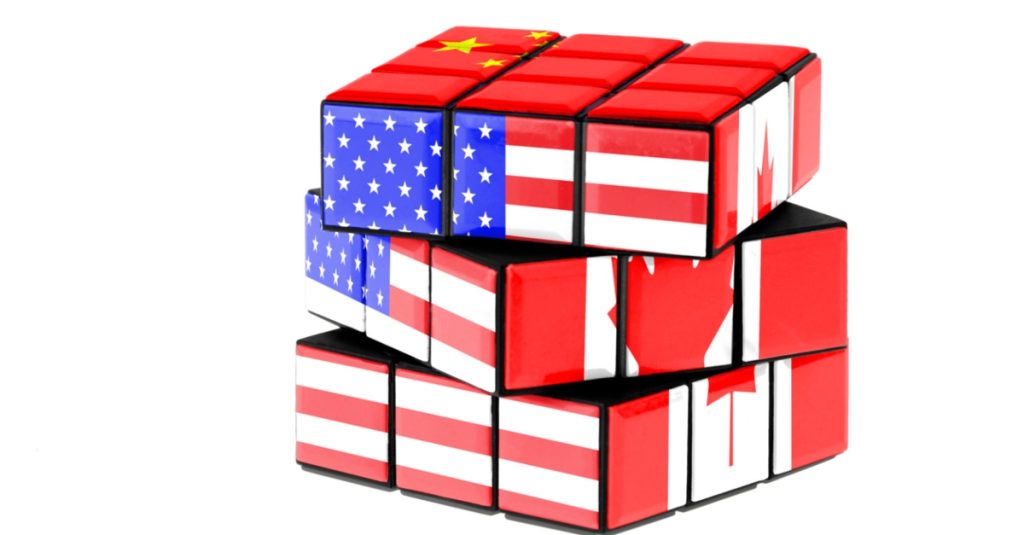
The environment that supported Canadian foreign policy since the end of the Cold War is fragmenting, with power politics returning to the centre of international relations and economic policy increasingly tied to strategic competition. Prime Minister Mark Carney’s speech at the World Economic Forum (WEF) reflected this assessment, arguing that the global governance framework is weakening and that middle powers face diminishing influence unless they adapt. His remarks focused on the need for resilience in national policy and reform of international institutions, while stopping short of endorsing a shift away from existing alliances.
President Donald Trump – at the same forum – presented a contrasting view. He framed international politics as a contest in which national advantage should drive policy. He stressed the importance of bilateral leverage and suggested that Canada’s prosperity and security remain closely tied to the US. His tone implied that alignment with Washington is expected rather than optional. This highlights the dilemma facing Ottawa. Canada seeks greater policy flexibility but remains structurally bound to the US via geography, trade and defence arrangements.
Engagement with China and economic strategy
Canada’s approach to China has shifted from confrontation toward cautious engagement. Ottawa has described this as economic risk management rather than a strategic pivot. Officials have argued that access to Chinese markets can reduce exposure to policy changes in Washington and provide opportunities for Canadian exporters. However, this approach is constrained by structural realities. The US remains Canada’s dominant trading partner, and North American supply chains are deeply integrated.
A visible move toward Beijing would likely provoke political reactions in Washington – Trump has said as much – and could result in sizeable economic countermeasures in sensitive sectors. Canadian policymakers therefore face a narrow margin for manoeuvre. China’s global strategy extends beyond commerce, and seeks influence in technology standards and international institutions. For Canada, this means that trade policy cannot be separated from strategic considerations. Domestic political sensitivities further limit how far Ottawa can go in expanding ties with China.
Arctic security and the Greenland scenario
The hypothetical takeover of Greenland by the US would, of course, drastically alter Canada’s security environment. Greenland’s location provides a platform for surveillance and early warning capabilities, and direct US control would expand American reach across the North Atlantic and Arctic. This would deepen Washington’s role in continental defence planning. Such a development would also offer improved deterrence capabilities for Canada but raise serious questions about its autonomy. Ottawa has struggled historically to fund Arctic infrastructure and monitoring systems, and a stronger US presence would address the capability gaps. Nevertheless, it would also reinforce asymmetry in decision-making on northern security issues. The symbolic implications for Canadian sovereignty in the Arctic would be significant.
China’s interest in Arctic research and shipping routes adds another layer of complexity. A strengthened US presence in Greenland would constrain Beijing’s ambitions, which does align with Canadian security’s stated preferences, but it would reduce the country’s ability and relevance as an intermediary actor in the region. Policy outcomes would be shaped by Washington not Ottawa.
Domestic politics and Alberta’s referendum
External policy choices are beginning to unravel against domestic political pressures – especially in Alberta – where a referendum on potential separation is signalling a persistent but strengthening dissatisfaction with federal policy. While immediate secession remains unknown, voting is expected to reflect the depth of grievance, later this year.
Foreign policy decisions are impacting these domestic dynamics. Energy markets, fiscal arrangements and climate commitments are being portrayed as harmful to Alberta’s (and other provinces’) economic interests, with the opposing view being that alignment with US industrial and energy policy will mean a loss of Canadian autonomy.
What no one seems to bring up, however, is that this is a very similar dichotomy that Carney will face with China too. It is difficult to see how he will be able to manage foreign policy in a way that does not intensify regional alienation. Missteps are already amplifying pressures within the federation.
Ethical scrutiny and electoral implications
Mark Carney’s political standing is also affected by scrutiny of his handling of blind trust requirements for Canadian prime ministers. Critics have questioned whether his financial arrangements sufficiently separate personal assets from public office. While no definitive findings have been issued, the perception would appear to be that governance safeguards have been applied far too loosely and pose a real political risk.
This issue is likely to feature in the next election cycle, expected in the spring. Opponents will say the blind trust controversy is evidence of elite detachment or insufficient accountability. For a leader presenting himself as a technocratic steward of a disrupted global order, questions about compliance with governance norms could very well undermine his credibility. Carney’s WEF remarks stressed the importance of institutional integrity and reform. Ethical controversies therefore have broader implications for his policy narrative and electoral prospects.
Canada’s strategic posture
Although Canada is unlikely to pursue a decisive realignment toward either Washington or Beijing, structural dependence on the US will continue to shape security and economic policy and, while diversification will remain a Carney policy objective, he may not have as much room to manoeuvre as he would wish for when both powers start to squeeze. This is creating a form of strategic ambiguity. Washington will interpret diversification as insufficient alignment, while Beijing will view caution as reluctance to deepen ties. Domestic audiences will perceive ambiguity as indecision in a political environment shaped by regional tensions.
A US takeover of Greenland would reinforce American dominance in the Arctic and accelerate competition in Canada’s northern environment, while Alberta’s referendum will illustrate how external alignment choices influence domestic political narratives, linking global strategy to federal cohesion.
Conclusion
Carney’s political future depends on his ability to navigate external constraints while maintaining domestic legitimacy, but his strategic narrative approach requires public confidence in his competence and integrity. Ethical scrutiny related to blind trust compliance creates a reputational vulnerability. Election timing increases the salience of this issue. Opponents are likely to link governance concerns to broader critiques of technocratic leadership and accountability. If diversification and resilience strategies fail to deliver visible economic outcomes, political support may erode further, particularly in regions where federal authority is already contested.
The era of predictable multilateralism is giving way to competition among major powers and fragmented economic governance. Carney’s characterisation of a global rupture captures this shift but also highlights the limits of middle-power agency.
To download a copy of this article, please click here.