
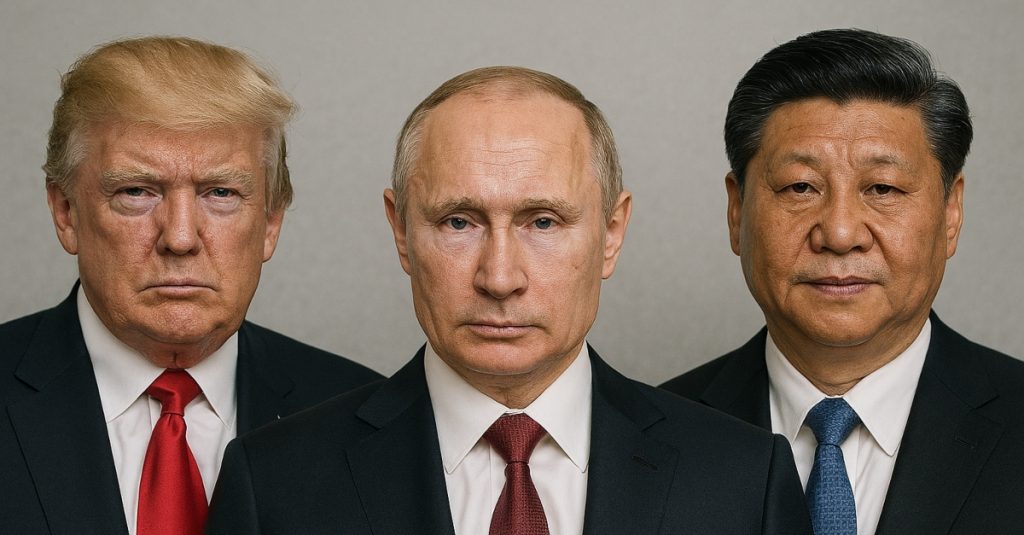
Not so long ago, BRICS dominated geopolitical commentary. Every conference, summit and economic forecast seemed to revolve around the rise of a new power bloc challenging Western influence. Yet today, discussion of BRICS appears noticeably muted. Perhaps this is because the world’s strategic landscape has evolved beyond the framework through which BRICS was originally understood. Indeed, attention has shifted toward the emerging America-Russia-China (ARC) dynamic, where co-operation between the three largest military and geopolitical powers may matter more than the formal structures of any economic grouping.
Executive summary
Recent diplomatic activity involving Presidents Donald Trump, Xi Jinping and Vladimir Putin appear more significant than many mainstream analyses suggest. From 13 to 15 May 2026, President Donald Trump conducted what both Washington and Beijing described as a highly successful summit with Chinese President, Xi Jinping. Officially, discussions focused on trade, the Iran conflict, and American arms sales to Taiwan. Trump described the visit as “very successful” while Xi characterised it as “historic“. Yet, despite the scale and symbolism of the meeting, no major breakthrough agreements were announced publicly.
For ARC observers, however, that absence of headline-grabbing agreements is precisely what makes the meeting interesting. Truly consequential discussions between major powers are not always accompanied by immediate public announcements. Both sides emerged speaking positively about the visit, while revealing relatively little about the substance of their discussions. What makes their meeting noteworthy is that Trump’s Beijing visit occurred after the legal downfall of former National Security Adviser, John Bolton.
Bolton had been prosecuted and subsequently agreed to plead guilty to charges unrelated to North Korea. However, his significance extends far beyond his legal troubles. Bolton has long been associated with the more confrontational wing of American foreign policy and is widely believed by many analysts to have played a major role in undermining Trump’s earlier diplomacy with North Korean leader, Kim Jong Un. Whether that interpretation is entirely accurate is almost beside the point. What matters is how events may be perceived in Pyongyang.
From an ARC perspective, Bolton’s removal from the strategic picture sends a signal. Kim Jong Un could reasonably interpret the development as evidence that Trump remains serious about pursuing peace on the Korean Peninsula. If Trump wished to reopen dialogue with North Korea, Xi Jinping would be the obvious intermediary. China remains North Korea’s most important partner and possesses influence that Washington does not.
Indeed, Xi has previously stressed the importance of maintaining close communication and strategic understanding with North Korea. One can envision Trump encouraging Xi to convey a simple message to Kim: the offer of peace remains open. More importantly, Xi could communicate that the major powers are prepared to co-operate where their interests align. The message would not come solely from Washington but from a broader understanding involving Beijing and Moscow as well.
The chronology becomes even more intriguing when viewed alongside developments involving Russia. Trump and Putin had already conducted their own major summit during the Russia-US meeting held in Anchorage, Alaska, on 15 August 2025. That summit represented a significant effort to stabilise relations between the two powers after years of tension and confrontation and, almost immediately following Trump’s recent Beijing visit, Putin travelled to China on 20 May 2026, to meet Xi Jinping. The two leaders used the occasion to reaffirm their strategic partnership, and discuss international stability and co-operation.
While this does not prove the existence of an ARC ‘structure’ – in fact, no one is suggesting it is in anyway formal – it is becoming rather difficult to ignore the pattern. Trump and Putin meet. A year later, Trump meets Xi. Xi then meets Putin. The three most influential leaders in the world today are engaged in sustained, high-level dialogue within a relatively short period.
Critics may dismiss such observations as coincidence. However, diplomacy often functions through patterns rather than proclamations. The significance lies not in any single meeting but in the cumulative effect of repeated engagement. The fact that these meetings occurred while major crises continue in Ukraine, the Middle East and East Asia, only strengthens the argument that some form of working arrangement is developing.
Additional evidence supporting this hypothesis can be found in ongoing energy discussions involving Japan. Negotiations continue between Tokyo and Washington over allowing Japan to maintain and potentially expand exemptions enabling imports of sanctioned Russian energy. Reports indicate discussions are underway, not only regarding Russian LNG but potentially crude oil as well.
Such an outcome would have been politically difficult to imagine only a few years ago. Yet, if Washington, Moscow and Beijing are gradually finding areas of pragmatic co-operation, then accommodating Japan’s energy security requirements becomes more understandable. It reflects a broader trend away from ideological confrontation and toward selective strategic co-ordination where mutual interests overlap.
Conclusion
Taken individually, each of these developments can be explained through conventional diplomatic reasoning. Collectively, however, they paint a different picture. The ARC hypothesis does not require a formal alliance, a treaty, or even public acknowledgement. It merely requires an understanding among the world’s principal powers that co-operation in key areas is preferable to confrontation.
Whether ARC ultimately emerges as a recognised geopolitical framework remains uncertain. What is becoming increasingly apparent, however, is that the world’s most important diplomatic conversations are occurring through direct interactions among Washington, Moscow and Beijing.
To download a copy of this article, please click here.