
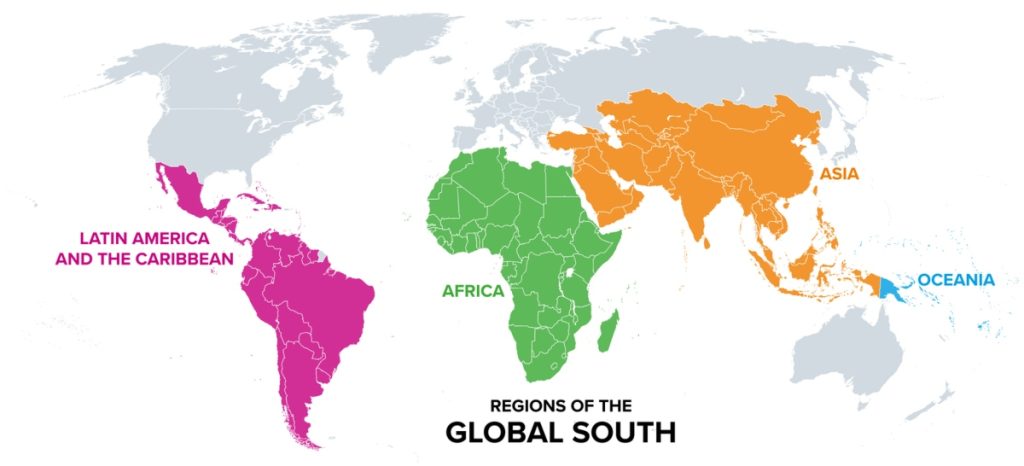
The term Global South has served as diplomatic shorthand for a loose coalition of developing states seeking greater voice in a world dominated by Western institutions and norms. The label implied shared grievances and converging interests, suggesting that formerly marginalised regions could act collectively to reshape global governance. Today, however, this narrative is increasingly hard to maintain. Diverging national agendas and deepening geopolitical rivalries have exposed a level of fragmentation that questions whether the Global South exists as a meaningful political category at all. Rather than a unified bloc, what is emerging is a patchwork of issue-based coalitions driven by transactional interests rather than ideological solidarity.
The problem of a manufactured cohesion
The concept of the Global South has long overstated the coherence of its supposed members. While the term captured a broad sense of historical exclusion from Western power structures, it masked rather deep differences in political systems, economic models, strategic priorities and regional interests; differences that are no longer manageable under a single conceptual umbrella.
In practice, economic interdependence, resource competition and heightened geopolitical tensions make it increasingly difficult for states in Africa, Asia, the Middle East and Latin America to align under shared positions. Several major states, once portrayed as natural partners, now find themselves on opposite sides of a raft of issues. As global power decentralises and multipolarity becomes more contested, the notion of a unified Global South becomes even more strained.
India and China: a foundational fracture
The most consequential divide lies between India and China. These two countries are frequently presented as pillars of Southern leadership. Yet, unresolved border disputes, military confrontations, widening trade restrictions and competing technological ambitions have pushed them into open strategic rivalry. Setting aside India’s security co-operation with the US, direct competition, especially in relation to manufacturing, means it’s at odds with Beijing’s regional and global ambitions.
China’s Belt and Road Initiative has similarly failed to produce a shared political identity among developing states. While some countries have benefited from infrastructure investment, others view the initiative as a source of debt exposure or political leverage. The lack of consensus on how to manage relations with China reveals that the Global South is not a bloc but a set of diverse national strategies responding differently to Beijing’s rise. This alone undermines the possibility of a unified Southern position.
Latin America’s disunity and strategic drift
Latin America, often referenced as a core component of the Global South, offers another example of fragmentation rather than cohesion. Brazil and Argentina (once aligned on regional integration through Mercosur) now diverge on trade policy, fiscal governance and, more importantly, external alignments. Brazil’s foreign policy increasingly centres on selective global engagement, such as climate diplomacy and selective economic partnerships, rather than regional solidarity. As its domestic political position is in flux, so too is its external leadership role.
Mexico’s key concerns are tied overwhelmingly to North American supply chains. Chile and Peru are in pursuit of investment-friendly policies that align more closely with Western capital markets than with any ‘Southern’ identity. Consequently, shifting political cycles across the continent prevent sustained collective diplomacy. Any claim that Latin America operates as part of a coherent Global South front is weak at best.
Africa: competing ambitions and external alignment
African states are equally diverse in their strategic interests. Despite rhetorical commitments to Pan-Africanism, economic competition and domestic political constraints shape divergent national agendas. Large resource producers focus on negotiating higher rents for critical minerals. Countries with growing manufacturing ambitions naturally push for industrial protection, while coastal states often put precedence on maritime security partnerships that do not align with continental priorities.
External actors add further complexity. Gulf states are now major investors in African ports, agriculture and logistics, where China’s presence is becoming increasingly contested. Western governments are now trying to re-engage on security, energy transition and supply-chain resilience.
These varied external relationships illustrate that African states no longer sit comfortably within a single geopolitical category, if they ever did. Their objectives reflect national and regional interests rather than participation in a unified Southern bloc.
The Gulf states: from south to systemic actors
The Gulf monarchies further demonstrate the limits of the Global South label. Their sovereign wealth funds, advanced logistics hubs and growing influence in energy markets and technology investment, place them closer to global financial and industrial power centres than to many developing states. Their priorities are largely incompatible with those of African mineral exporters or South Asian manufacturing economies.
These states increasingly operate as autonomous geopolitical actors rather than as members of a notional Global South.
The Rise of issue-based coalitions
As the coherence of the Global South erodes, states are increasingly turning toward flexible, narrowly focused coalitions that form around specific policy needs rather than ideology or historical identity. These alliances are pragmatic, temporary and transactional. They allow governments to pursue maximum advantage in particular domains, without committing to broader political or strategic alignment.
In the realm of supply-chain restructuring, geopolitical risk has generated new forms of mini-lateral co-operation, particularly across the Indo-Pacific. Japan, South Korea, India and Southeast Asian economies are building tighter co-ordination around semiconductors, critical minerals, maritime logistics and strategic manufacturing. These partnerships are explicitly designed to enhance resilience, diversify production networks and insulate key industries from great-power rivalry. Their formation reveals how states now favour sector-specific security and technological alignment over historical or ideological affinities.
These developments reveal a diplomatic landscape no longer organised around rigid blocs but around overlapping networks of co-operation. States increasingly prefer to work through agile, sectoral arrangements that allow them to protect their interests in specific areas, while maintaining autonomy elsewhere. This describes the complexity of today’s multipolar world far more accurately than the outdated notion of a unified Global South.
What comes after the Global South?
As the Global South dissolves as a meaningful construct, the world will not revert to simple bipolarity or restored Western dominance. A more complex and fluid multipolarity is in the process of emerging by overlapping networks of co-operation rather than large blocs. States increasingly seek influence through institutional innovation, targeted partnerships, technology alliances and supply-chain agreements.
Historical grievances against Western-dominated systems remain real, but they no longer translate into unified political action. Instead, states are pursuing reform or leverage on a case-by-case basis, driven by pragmatic calculations rather than group identity.
Conclusion
The Global South is losing coherence because its internal contradictions are becoming impossible to ignore. India confronts China militarily and economically, the Latin American states are moving in sharply different directions, Africa is being shaped by competitive industrial strategies, and the Gulf monarchies are operating as global investors rather than as members of a developing-world bloc.
The collapse of the Global South narrative is not a geopolitical failure but a correction that acknowledges the diversity of national priorities in an increasingly fragmented and multipolar world.
To download a copy of this article, please click here.