
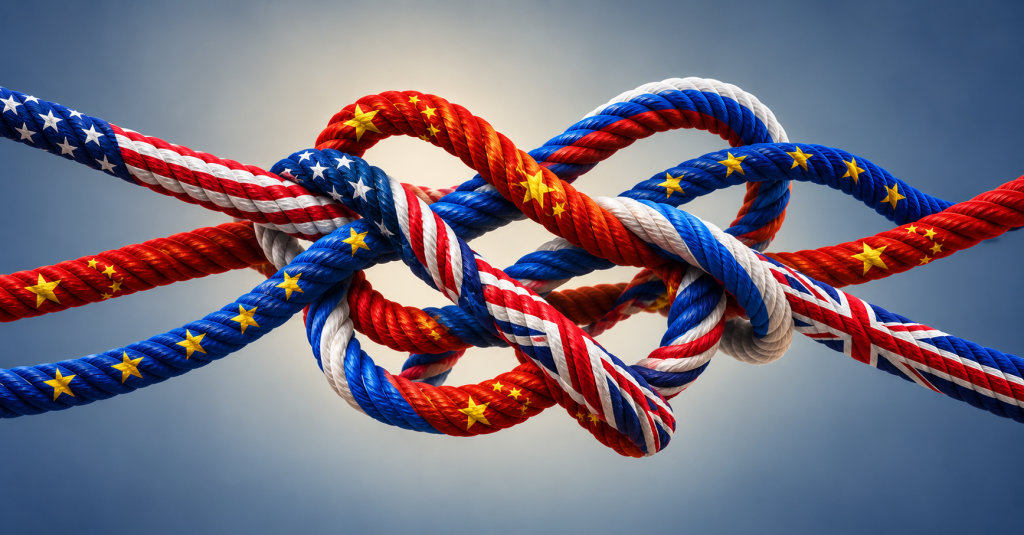
Canada’s trade talks collapse with the US should not be viewed simply as another tariff dispute between neighbours. The timing, as with everythinapse with the g in today’s world, matters. Prime Minister Mark Carney suspended negotiations on 21 August, little more than ten weeks before the 3 November mid-term elections in the US. Washington says Ottawa’s late demands became uneconomic and had stopped negotiating in good faith, while Ottawa claims the White House infringed on Canadian sovereignty.
The hard truth is that Carney never regarded a comprehensive US agreement as part of his strategy, despite his promises during the last Canadian election. On 22 August, the Prime Minister said that building at home and diversifying trade abroad was “not our Plan B” but “our Plan A from the start”. If that was genuinely Plan A, the collapse of talks cannot be explained away as something Trump forced on Canada.
Executive Summary
The last couple of years have seen an increasing scalation of the threat of war. It seems as if every new day brings a new diet of explosions, fires, drone sightings, infrastructure failures and suspected terrorist incidents across Europe. It could be argued that mainstream media has (along with many European government officials) hyped the war narrative for all its worth. Simply put, “the Russians are coming”. Almost immediately after any event, suspicion is quickly steered towards blaming Russia/Putin even before investigators have had a chance to examine the scene.
This is not to say that Russian operations are all imaginary. There is evidence that Russia and other states do engage in such activity. However, more often than not, the truth behind many of these events is not what we are being told. Fear and distrust are powerful tools and, once the public has been conditioned to fear, almost any unexplained event involving military infrastructure, energy installations, etc will be seen through that lens without effort. Any unexplained incident, therefore, acquires strategic and political narrative long before evidence catches up with rhetoric.
The 24 to 48 hour rule
For the good of your health (remaining in a long-term high stress state is extremely unhealthy) and for those who really want to get a better understanding of these events without becoming overwhelmed by them, a useful personal practice is to avoid forming firm conclusions during the first twenty-four to forty-eight hours after a major incident. This should never replace immediate official safety instructions where physical danger exists, but it is a media-consumption rule. During the following days, forensic evidence will begin to emerge, incorrect early reporting will generally be corrected, and competing explanations can then be compared.
A few examples where media and officials said that Russia was involved but either it wasn’t or the “strong evidence” turned out to be inconclusive:
Drone incidents over UK military bases – Late 2025
Unidentified drones were reported over British military facilities, including bases associated with US forces and nuclear weapons. These incidents were subsequently incorporated into claims that Russia had been conducting a wider drone-surveillance campaign against NATO military infrastructure. However, a British defence investigation found no evidence conclusively linking the UK drone sightings to Russia. The later IISS assessment considered Russian involvement likely on the basis of patterns and nearby vessels, but the official British investigation itself did not establish attribution.
Suspected second drone at Leipzig/Halle Airport – August 2026
During the attempted drone attack at Leipzig/Halle Airport, investigators initially believed that a second hostile drone had collided with a DHL cargo aircraft after the airport was temporarily closed. This became part of the early picture of a co-ordinated multi-drone attack and contributed to suspicions of a sophisticated foreign-state operation. Germany formally blamed Russia for the principal explosive-drone incident. However, investigators subsequently cast doubt on whether the aircraft had actually struck a drone at all.
Emco ammunition depot fire, Bulgaria – 10 August 2026
A major fire broke out at an EMCO ammunition facility near Tryavna in Bulgaria. EMCO facilities had previously experienced unexplained explosions investigated for possible Russian involvement. Consequently, the new fire was rapidly incorporated into wider discussion about Russian sabotage against Europe’s defence industry. However, management at the facility stated that there was nothing indicating outside interference. The preliminary assessment suggested the fire had begun within the facility before spreading.
KNDS ammunition factory explosion, Italy – 13 August 2026
A major explosion followed a fire at the KNDS Ammo Italy plant at Colleferro, south of Rome. The incident occurred only days after the Bulgarian ammunition facility fire. The timing, combined with the military nature of both facilities, understandably produced speculation that Europe might be witnessing a co-ordinated Russian sabotage campaign. Nevertheless, Italian Defence Minister Guido Crosetto subsequently pushed back against this interpretation, saying the government had seen nothing indicating Russian involvement.
German electricity infrastructure sabotage – September 2026
Explosive devices and conductive material were used in attacks against German electricity infrastructure. The incidents occurred against the background of several unexplained attacks involving defence-related targets and therefore became associated with the narrative of Russian hybrid warfare. However, German authorities said investigators had not established the origin, motivation or perpetrators. Foreign involvement remained possible, but domestic extremist groups were also considered, particularly because Germany has previously experienced politically motivated attacks against electricity infrastructure.
The historical warning
History provides reasons for caution when dramatic incidents are used to accelerate major political or military decisions. The immediate catalyst for WWI was the assassination of Archduke Franz Ferdinand, heir to the Austro-Hungarian throne, in Sarajevo on 28 June 1914. His death did not independently cause the First World War (Europe was already divided), yet the assassination created the crisis through which those existing tensions were transformed into general war. Today governments and traditional broadcasters don’t possess anything approaching the monopoly over information that existed during either 1914. Smartphones, social media, independent journalists, satellite imagery, specialist researchers and open-source intelligence communities can challenge official narratives extraordinarily quickly.
Conclusion
Recognise that international crises create incentives for governments, political movements, media organisations, activists and hostile intelligence services to frame events in ways that support their preferred interpretation. The modern communications environment gives today’s public something previous generations did not possess, the ability to watch the narrative evolve or unravel almost in real time. So, when the next major incident occurs, pause for a day or two, and say to yourself, “Maybe.”
To download a copy of this article, please click here.


